

One of the most common questions we hear from Maranatha parents in the Junior School is: When should I give my child a smartphone?
While every family is different, research is becoming increasingly clear that the age a child receives their first smartphone matters, and waiting longer can make a meaningful difference.
“We are facing the least flourishing generation since records began…Delaying a child’s access to a smartphone is the single best parenting strategy in the modern age.” Jonathan Haidt
I hope some of you have heard of Jonathan Haidt, the author of the seminal text, Anxious Generation. This book has changed the conversation on smartphones and social media globally.
Haidt speaks about 4 norms necessary to turn things around:
- no phones until 8th grade in the USA (age 14)
- no social media before 16
- phone free schools
- more independence in the real world

Wait Mate (2026) Publication content URL https://www.waitmate.org.au/
If you haven’t read the book, I strongly recommend you put it on your reading list or listen to a podcast where he is interviewed.
Why Waiting Matters
We call them ‘smartphones’, but it’s a pretty misleading name. It would be more accurate to call them handheld supercomputers, that put the whole of the internet in your pocket 24/7.
Former Google ethicist Tristan Harris refers to smartphones as “slot machines in kids’ pockets, designed to exploit their brain chemistry”.
I’m not a psychologist but let me tell you a bit about the brain. Early adolescence, ages 10-14 is a critical time for brain development. Whatever kids do most during this time shapes those brain circuits for life.
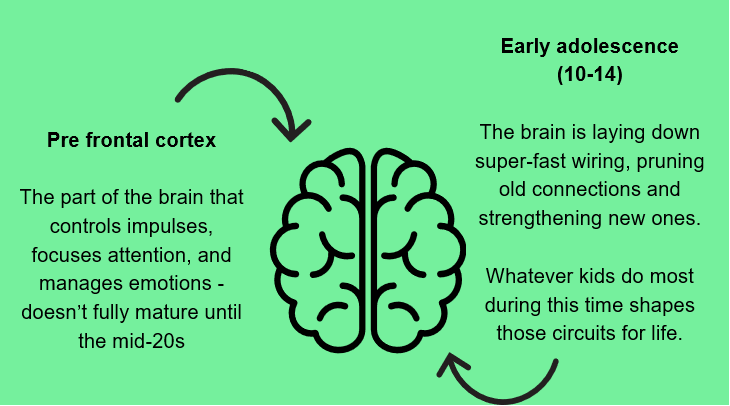
“Whatever kids do most during this time shapes those circuits for life..”
A Practical Approach for Families
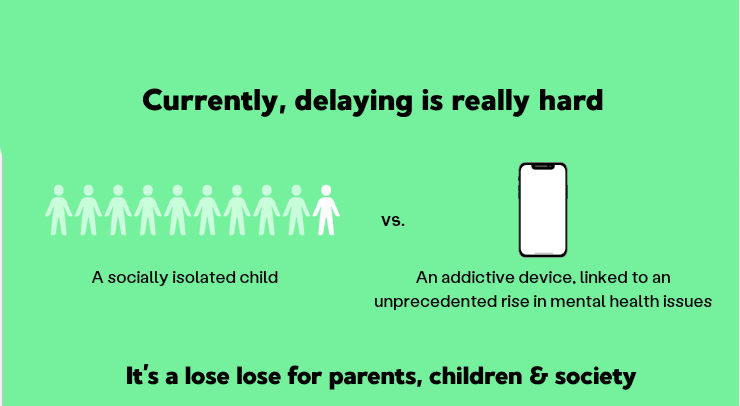
Despite the risks, delaying is currently very hard, and to those whose children already have devices in primary school, there is no judgment here, just acknowledgment of the challenging choice between a socially isolated child and the possession of an addictive device.
The question is not simply if, but when and how. There are plenty of other alternatives. If your child needs a phone, consider a simple phone that only has the ability to call and text a select group of numbers. The number of good alternatives is rapidly growing.
There are many alternatives, here are some examples:

These options allow children to stay connected when needed, without immediate access to apps, social media and the wider internet.
In Conclusion
A shared community commitment to delay providing children with smartphones can significantly strengthen collective acceptance and support improved wellbeing for all families.
What the research does suggest is simple:
There is now overwhelming research that connects the rise of a phone-based childhood with the mental health crisis we are seeing for teens, with the work of Jean Twenge and Jonathan Haidt leading in this space.
Even delaying smartphone access by a year or two can have a positive impact on a child’s wellbeing.
As a Maranatha community, we encourage thoughtful, informed decisions that allow our children to grow, develop and enjoy their childhood for as long as possible.
All content and studies in this blog are sourced from the Wait Mate organisation.
Maranatha is dedicated to work in partnership with Wait Mate to connect parents who want to delay giving their kids smartphones.

Jenny Rus
Director of Junior School
Maranatha Christian School

Every Part Matters
In our leadership blog, Head of Senior School Ms Sarah Kapranov explores genuine partership at...
Aug

Officer Campus Update
Read the latest Officer campus update, highlighting a new competition-sized soccer oval and preparations for...
Aug

Year 11 & 12 VM Melbourne Careers Expo
Maranatha VCE Vocational Major students attended the Melbourne Careers Expo, exploring future study, training and...
Aug

Junior Clubs
Explore the Junior School Clubs Program at Maranatha Christian School, where students build confidence, develop...
Jul

High School Musical Production
Maranatha Secondary students are back on stage with this year’s production of High School Musical....
Jun

Combined Junior Awards Assembly
Our Junior School Awards Assemblies were held across both campuses, celebrating the outstanding efforts of...
Jun
Rite Journey Hike
Our Year 9 students rose to the challenge last week as they completed their first...
Jun

When is the Right Time for a Smartphone?
In our latest Leadership Blog, Mrs Jenny Rus (Director of Junior School) shares how research...
Jun