

Last term, I wrote about delaying giving your child a smartphone and why that can be a positive decision for many families.
Recently, I listened to a thought-provoking presentation by Dr Chris Watkin, whose ideas reinforced many of the conversations we have been having at Maranatha about helping students build strong foundations before increasing their access to digital tools.
It prompted me to ask a similar question:
When is the right time to give my child a Laptop?
At Maranatha, we value technology and recognise that our students will need to be digitally capable and confident in a rapidly changing world. However, before students can effectively use technology, they first need to develop the ability to think deeply for themselves.


What We Are Seeing
As parents and educators, we are noticing that many children are finding it harder to sustain attention, persevere with challenging tasks and engage deeply with learning.
This should not surprise us. Recent Australian Bureau of Statistics data found that only around one in four children aged 5-17 meet recommended screen-time guidelines, with children spending an average of almost three hours per day on recreational screen activities. [abs.gov.au]
Our children’s world is filled with notifications, videos, games and endless streams of information competing for their attention. Learning requires concentration, effort, persistence and sustained thinking. These habits become harder to develop when screens are constantly demanding attention.
The Challenge of AI
Artificial intelligence has made this conversation even more important.
Today, students can generate answers, essays and ideas within seconds. However, if they have not developed strong foundations in reading, writing and critical thinking, they often lack the ability to judge whether those responses are any good, accurate or appropriate.
- In other words, they can produce an answer without necessarily understanding the answer.
Restricted Technology Use
At Maranatha, technology has always been viewed as a tool to support learning rather than drive it. As we continue to review research and educational practice, we remain committed to an intentionally balanced approach. Technology will continue to have an important place in our classrooms, but it will be used purposefully and at appropriate times rather than becoming the default tool for every learning task.
You will continue to see a strong emphasis on:
- Handwriting and written responses
- Reading printed texts
- Explicit teaching
- Rich classroom discussion
- Practical learning experiences
- Collaborative problem-solving
- Building sustained attention and focus
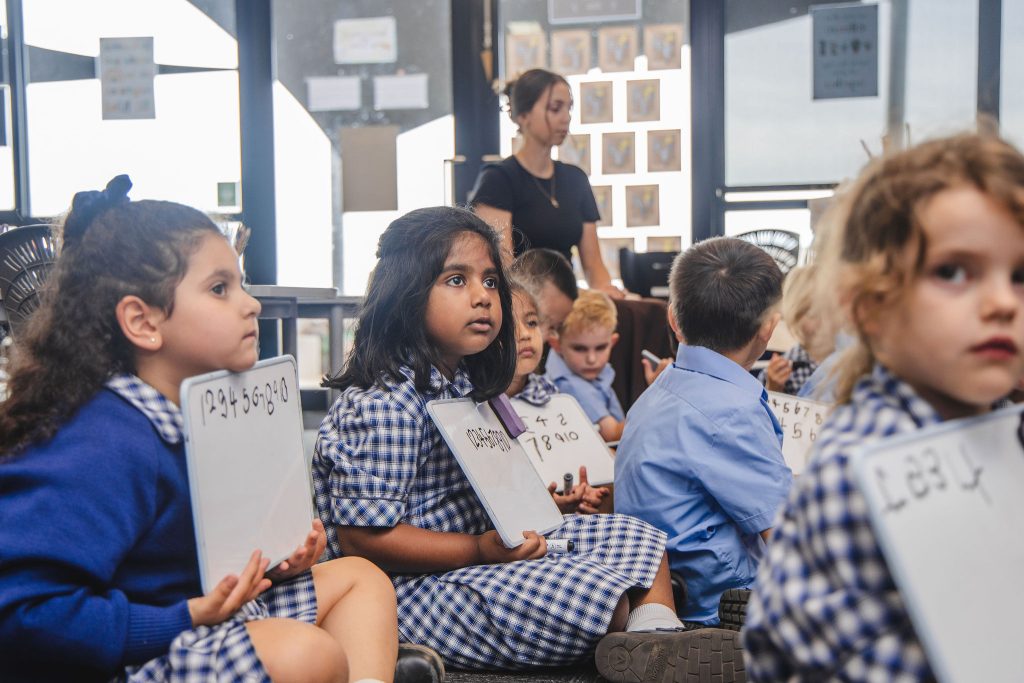
A recent review of 24 studies found that students who took handwritten notes achieved stronger learning outcomes than those who typed notes, with handwriting helping students process and retain information more effectively. [link.springer.com]
Delaying the Laptop
Just as many families are reconsidering the timing of introducing smartphones, there is value in asking whether every primary-aged child needs access to a laptop. Our goal is not simply to raise children who can access information. Our goal is to raise young people who can think wisely, evaluate ideas critically and use technology as a tool rather than becoming dependent upon it.
Technology will always be waiting for them. Childhood will not.

Jenny Rus
Director of Junior School
Maranatha Christian School

A Time for Formation Before a Time for Technology
Our latest Leadership article by Mrs Jenny Rus, Director of Junior School, explores why delaying...
Sep

Empathy: Learning to Understand Others, so We May Love Well.
Our latest Leadership Article Mrs Dutlow, Head of Endeavour Hills explores how empathy shapes relationships,...
Sep

Prep Healesville Excursion
Maranatha Prep students visited Healesville Sanctuary, where they encountered some incredible creatures and discovered more...
Sep
Leadership Assembly
Maranatha inducted our School Captains, Senate members, and student leaders for 2027, while also thanking...
Sep

Year 6 Gala Day
Our Year 6 students recently represented Maranatha at the Year 6 Gala Day, participating in...
Sep
Association Dinner
Maranatha Association Members came together for their annual dinner. The highlight of the evening was...
Sep
Year 5 Oz Rocks Competition
Year 5 students have achieved outstanding results in the recent Oz Rocks competition, a national...
Sep

Wellbeing Week 2026
Across our Maranatha campuses this week, students will be exploring the many aspects of wellbeing...
Sep